What regeneration means to Wovenbeyond
Regeneration is a word that appears more and more frequently in conversations about agriculture, fashion and sustainability. Yet despite its growing popularity, it often means different things to different people.
Too often, regeneration is reduced to a marketing message, a carbon calculation or a set of metrics used to measure environmental impact. While these tools can play an important role, they are only part of the story.
At Wovenbeyond, we see regeneration as something far more fundamental.
The information used to measure impact must come from somewhere. Before there are reports, data points or sustainability targets, there is land. There are ecosystems. There are farmers, growers and communities working in relationship with nature every day.
For us, regeneration begins there.
It is a way of thinking and designing that takes inspiration from living systems: creating products, relationships and business models that contribute more than they take.
"Before there are reports, data points or sustainability targets, there is land."
Learning from nature
When we look closely at natural ecosystems, we find a remarkable pattern.
Nature does not create waste.
Leaves fall to the ground and become nutrients for the soil. Plants capture sunlight and transform it into energy. Animals, insects, fungi and microorganisms participate in complex networks of exchange that allow ecosystems to evolve, adapt and thrive.
Everything has a role.
Everything is connected.
Everything eventually becomes a resource for something else.
For us, regeneration begins with paying attention to these lessons.
Rather than asking how we can reduce harm, we can ask a more ambitious question:
How can we design systems that actively create positive outcomes for people and the planet?
"Nature does not create waste. It creates cycles."
Designing materials differently
This perspective has shaped Wovenbeyond from the beginning.
Every material we choose tells a story about the future we want to help create.
Natural fibres such as wool and Himalayan nettle are renewable resources that originate within living systems. They connect us to landscapes, farming communities and ecosystems in ways that synthetic materials cannot.
But regeneration is not only about where a material comes from.
It is also about where it goes.
Many modern products are designed with no consideration for what happens at the end of their life. They become waste because waste has been designed into the system from the start.
Nature works differently.
Inspired by principles such as Cradle to Cradle and Biomimicry, we believe materials should be designed with their next life in mind.
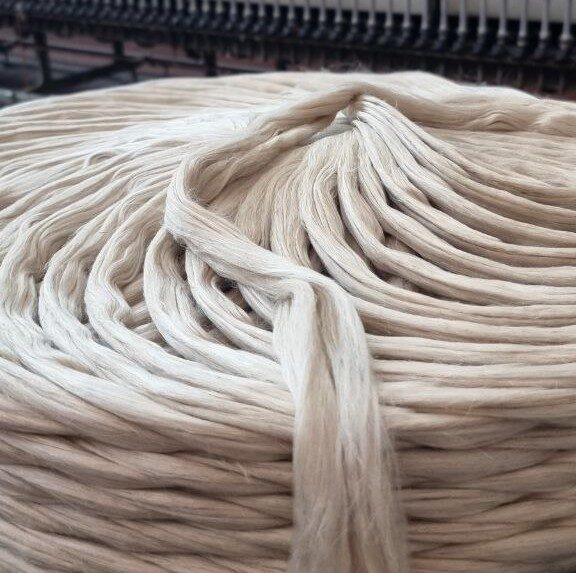
This is one of the reasons our yarns are made from natural fibres and are intended to return safely to the soil at the end of their useful life. In the right conditions, they can become nutrients for future growth rather than waste destined for landfill.
Designing business differently
The same thinking extends beyond materials.
Healthy ecosystems do not thrive through extraction. They thrive through relationships.
Every participant contributes to the health of the whole system.
We believe businesses can learn from this principle.
Regeneration is not only about improving soil health or biodiversity. It is also about creating economic systems that value the people who make them possible.
Farmers, fibre processors, manufacturers, designers, makers and consumers all play a role in the journey of a fibre.
When value is distributed more fairly, knowledge is shared and long-term relationships are prioritised, the entire system becomes stronger and more resilient.
Regeneration is about more than the environment
At Wovenbeyond, regeneration includes the restoration of ecosystems, but it also includes the preservation of cultural heritage, traditional knowledge and rural livelihoods.
Many natural fibres carry stories that have been passed down through generations. They represent relationships between people and place, between communities and landscapes.
Protecting these relationships is just as important as protecting the environments that support them.
For us, a truly regenerative future is one where ecosystems, communities and craftsmanship can thrive together.
Looking forward
Regeneration is not a destination.
It is an ongoing process of learning, observing and improving.
It challenges us to think beyond individual products and consider the wider systems of which they are a part.
At Wovenbeyond, regeneration begins with a simple belief:
That by learning from nature, we can design materials, businesses and relationships that leave the world healthier, more connected and more resilient than we found it.
Not by taking less.
But by giving back more.